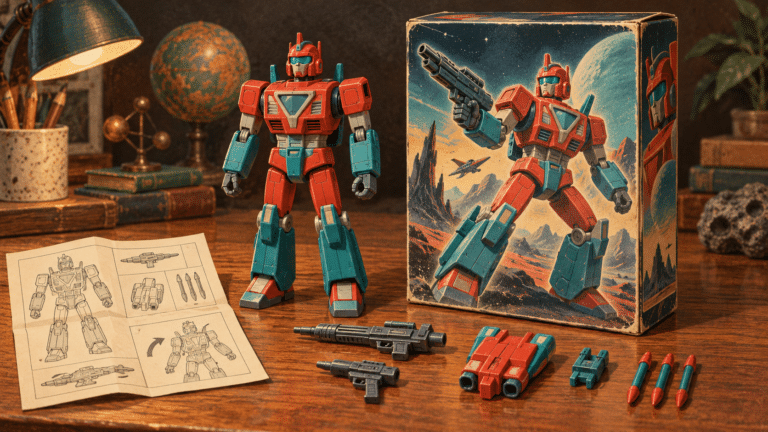
The vintage action figure market has quietly become one of the most-faked corners of the collectibles world. Reproduction Kenner Star Wars weapons, resin-cast He-Man knockoffs, Chinese-market G.I. Joe copies, custom-painted “prototypes” with no provenance — they’re all out there, and they’re getting better every year.
Quick Answer
Every authentic vintage action figure carries five verifiable signals: correct plastic feel and color, correct paint application, correct joint type and function, correct mold markings, and correct proportional details. Reproductions almost always fail at least two of the five. Check them in that order and you can spot a fake before you buy.
The good news: authentication isn’t hard once you know what to look for. It’s a six-point checklist that takes about two minutes per figure. This guide walks through every step, plus the specific tells for the biggest vintage lines: Star Wars, He-Man, G.I. Joe, and Transformers.
The Short Answer
Every authentic vintage action figure carries five verifiable signals: correct plastic feel and color, correct paint application quality, correct joint type and function, correct mold markings, and correct proportional details. Reproductions almost always fail on at least two of the five. Learn to check them in the order below and you’ll catch 95% of fakes in under two minutes.
Check #1: Plastic Feel and Color
Original vintage plastics have a specific feel. Kenner Star Wars figures used a slightly softer polymer with a matte, semi-porous surface. Mattel He-Man figures had a firmer, glossier plastic that developed a specific yellowing pattern over time. Hasbro G.I. Joe used harder plastics with tighter tolerances.
Reproduction figures — especially modern castings — feel different in the hand. Often too smooth, too light, or with a plasticky sheen that looks “wet” under indirect light. Original 40-year-old plastic feels aged. Reproductions feel new.
Color is the second half of this check. Authentic vintage figures have a very specific hue variance from the factory. Fakes often over-saturate colors or use slightly off shades. If a Boba Fett cape looks too green, or a He-Man loincloth looks too orange, ask why.
Check #2: Paint Application Quality
Vintage factory paint apps are inconsistent by modern standards. That inconsistency is a signal of authenticity. Original Kenner Star Wars figures have paint edges that are slightly rough under 10x magnification — you can see the brush or spray-mask pattern. Original He-Man face paint bleeds slightly around the eyes. Original G.I. Joe camo has visible aerosol spray patterns.
Reproductions almost always have cleaner, sharper paint edges. Modern manufacturing tolerances are simply better than 1980s factory floors. If a supposed 1979 Boba Fett has laser-crisp helmet stripes with zero overspray, that’s a warning sign — not a compliment.
Authenticated Vintage Star Wars Kenner
Filter for complete and verified Kenner figures with provenance photos.
View Kenner Star Wars →Check #3: Joint Type and Function
Every vintage line had a specific joint construction. Learning these lets you catch replacement parts and full reproductions in seconds.
- Kenner Star Wars (1978-1985): Five points of articulation (head, arms, legs). Metal pin construction visible through leg cavities. Joints should have moderate resistance — not floppy, not stiff.
- Mattel He-Man (1982-1988): “Power punch” spring waist. Rubber-band internal mechanism — over decades these degrade, so most originals now have weaker snap-back than day-one. A crisp snap on a 40-year-old figure is a red flag.
- Hasbro G.I. Joe (1982-1994): O-ring waist construction. Torso screws are single-slot Phillips, always brass or silver, never black. Missing or replaced O-rings are the biggest tell for tampered figures.
- Hasbro Transformers (1984-1990): Diecast weight matters. Original Generation 1 figures have specific alloy density — reproductions often feel wrong in the hand.
Check #4: Mold Markings
This is the single fastest authentication check for most figures. Every authentic vintage line has factory mold stamps in specific locations, with specific text.
- Kenner Star Wars: Right leg back or torso back. Reads “GMFGI” (General Mills Fun Group Incorporated), country of manufacture (typically Hong Kong or China), and year. Missing or altered stamps = reproduction.
- He-Man: Inside of thigh or back. “© Mattel Inc.” with year. Repros usually have blurry, uneven stamp text.
- G.I. Joe: Inside of torso pieces. Hasbro copyright, country, year. O-ring style figures have very specific text conventions by year.
If a seller won’t share close-up photos of mold stamps on request, walk away. Legitimate sellers know this is a standard authentication ask and will provide it in seconds.
Check #5: Proportional Details
Reproductions are often cast from a single reference figure and inherit that reference’s exact wear or damage. Sometimes they’re scaled slightly off. Always compare the figure in question to a verified reference photo — face sculpt proportions, helmet size, weapon holsters, cape drape.
Common tells: heads that sit slightly too small on the body, weapons that fit “wrong” in the hand grip, capes that don’t lay against the shoulders correctly, feet that don’t stand flat. These are all signs of reproduction molds that don’t match factory specs.
Check #6: Provenance and Packaging
For carded, CIB (complete in box), or MOC (mint on card) figures, the packaging itself is often the biggest authentication signal. Reproduction cards and boxes exist — and some are convincing — but there are specific tells.
- Print color and quality: Original 80s card art was printed with specific inks that have a particular saturation and aging pattern. Modern reprints often look “too clean.”
- Bubble/blister: Original PVC blisters yellowed and slightly warped over decades. Perfectly clear blisters on a supposed 1982 figure are a huge red flag.
- UPC codes: Reproduction packaging often has incorrect UPCs or ones that don’t scan properly. Cross-reference with published vintage line UPCs.
- Cardback item counts: The number of figures shown on the back of a card corresponds to a specific year of that line. Wrong count = wrong year = reproduction.
Vintage He-Man Complete Figures
See current listings for Mattel He-Man figures with weapons and accessories.
View He-Man Figures →Red Flags in Listings
Before you even inspect the figure, the listing itself will often give away authenticity risk.
- “Custom” or “restored” or “professionally repainted” — means the figure has been altered from its original factory state. Value is significantly reduced regardless of quality.
- Zero close-up photos of mold stamps. The most authenticity-relevant photos are missing.
- “From my personal collection since childhood” without provenance photos — harmless in itself, but often used to preempt questions.
- Seller has no vintage toy sales history. Established vintage dealers have reputation to protect. New sellers dumping high-value vintage figures deserve extra scrutiny.
- Prices notably below market. A “1979 Kenner Boba Fett rocket-firing prototype” at $200 isn’t a bargain — it’s a lie. Real vintage rarities carry realistic prices.
The Provenance Question
For high-value figures, always ask the seller: Where did you get this figure? The good sellers have an answer. Estate sale, collection breakup, inherited from a relative, purchased 15 years ago from a known dealer. The answer doesn’t need to be exciting — it just needs to exist.
Sellers who can’t or won’t answer this question are worth avoiding on anything above $200. Legitimate provenance is one of the biggest protections against forgery in vintage toys, and legitimate sellers know it.
The 2-Minute Authentication Routine
Run this every time, on every figure, before you commit real money.
- Photos: Do you have close-ups of mold stamps, all joints, all paint apps, packaging front and back? If no, ask. If seller won’t provide, walk.
- Reference check: Compare against 2-3 verified reference photos of that exact figure and year.
- Plastic + paint scan: Right color, right saturation, right factory imperfections?
- Joint construction: Correct method for that line and year?
- Mold stamps: Correct location, correct text, correct year?
- Provenance: Does the seller have a story that explains where the figure came from?
Bottom Line
Vintage action figure authentication isn’t magic — it’s a checklist. The market is full of reproductions, but 95% of them fail at least two of the six checks in this guide. Learn the pattern, run the routine, and you’ll build a collection you can trust for decades.
The alternative is buying from dealers who do this authentication work upfront — verified provenance, honest condition grading, transparent return policies. That’s the way most serious vintage toy collectors build their long positions without spending every weekend running loupe checks.
Verified Vintage Toys, Every Time
Every vintage figure in our vault is authentication-checked, provenance-verified, and honestly graded. No fakes, no repro, no bullshit.
Shop Vintage Toys → Complete in BoxRelated reads: Best 80s Action Figures for Collectors in 2026 · CIB vs Loose: What is the Value Difference? · Nostalgia Revivals: Care Bears, Furby, Littlest Pet Shop Are Surging in 2026
Shop it at Nostalgik Vibes: Browse vintage toys →
Don’t see the exact issue or piece? See live listings on eBay →