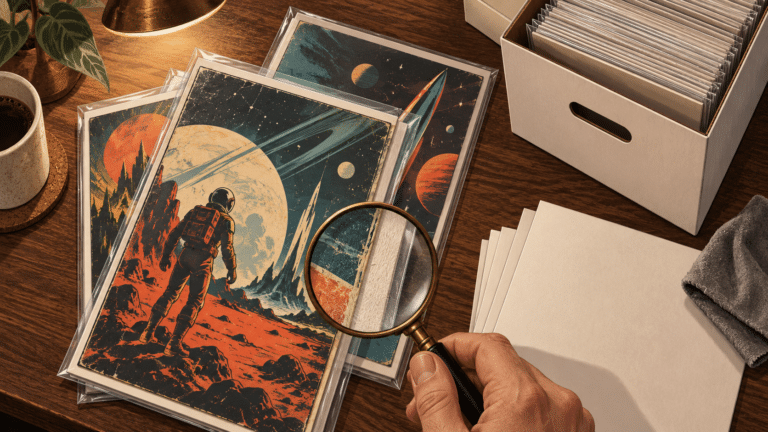
The best way to start collecting horror comics is to choose a lane before you choose a “key.” Pick the kind of fear you enjoy—classic anthology, vampires and monsters, supernatural mystery, survival horror, licensed franchises, or cover art—then buy a readable entry point and one or two issues you genuinely want to keep.
That approach is more satisfying than chasing whatever looks expensive in a social post. Horror comics span different eras, formats, publishers, and audiences, and condition can matter as much as the title. A good Halloween collection can be inexpensive, carefully curated, and still feel personal.
Start with the kind of horror you actually like
Horror is a shelf, not a single genre. Use this quick map to find your entry point.
| Collecting lane | What it offers | Beginner-friendly format | What to inspect |
|---|---|---|---|
| Classic anthology | Short stories, suspense, monsters, twist endings | Reprints or collected editions before original issues | Printing, completeness, paper quality |
| Vampire and gothic | Long-running characters, dramatic painted or illustrated covers | Trade paperback or a short modern run | Volume and issue numbering |
| Survival and zombie | Character-driven long stories with escalating stakes | Compendium, trade, or first story arc | Reading order and edition |
| Modern creator-owned | Current series, new mythology, accessible first arcs | Volume 1 trade or standard-cover #1 | Variant versus standard edition |
| Licensed franchise | Familiar film, game, or television worlds | Self-contained mini-series or collected edition | Publisher, year, license, printing |
| Cover-art collecting | Artists, themes, foils, virgin covers, connecting sets | Standard and open-order variants | Exact cover designation and condition |
None of these lanes is automatically “better.” A worn classic issue can be a more interesting keeper than a flawless modern variant, and a trade paperback can be the best purchase when your goal is reading the story.
Classic horror: history first, hype second
Pre-Code horror is the natural history shelf of the category. Crime and horror comics became a major target of public criticism in the early 1950s, and publishers formed the Comics Magazine Association of America and adopted the Comics Code in 1954. The Code sharply restricted horror content; later revisions relaxed some rules, and direct-market distribution eventually made it easier for publishers to release material outside the Code.
For a new collector, original mid-century issues can be a difficult first purchase. Paper is fragile, restoration can be hard to spot, and a dramatic cover can attract aggressive pricing. Start by learning through reputable reprints and collected editions. Then, if you want an original issue:
- confirm the exact title, issue number, publisher, and publication date;
- check that the cover and all interior pages are present;
- look for detached staples, spine splits, missing pieces, tape, trimming, color touch, and moisture damage;
- compare the copy with archived issue data and other photographed examples; and
- buy from a seller who describes defects instead of hiding them behind a single grade.
Do not assume “old” means rare, valuable, or a good investment. Survival, demand, condition, edition, and provenance all matter, and the market can change.
Vampirella and gothic cover collecting
Vampirella is a useful bridge between horror reading and cover-art collecting. The character has appeared across many volumes, specials, crossovers, and collected editions, and Dynamite’s current catalog alone separates several Vampirella series and specials.
That makes exact identification essential. “Vampirella #1” is not a complete description. Record:
- publisher;
- volume or series year;
- issue number;
- cover letter or variant designation;
- artist;
- printing;
- whether the book is a standard, incentive, foil, virgin, or retailer-exclusive cover; and
- whether any signature is witnessed, certified, or simply represented by the seller.
If the art is what you love, collect the artist or visual theme rather than trying to complete every cover. One carefully chosen painted cover, one modern interpretation, and one readable collected edition can make a stronger personal set than a stack of near-duplicates.
Start with the Nostalgik Vibes comic-book shop. Relevant examples include our Vampirella 2026 #1 Cover A–E five-comic set and Vampirella Armageddon #10 four-cover set. These were listed in stock when checked on October 6, 2026; check each product page for current availability and condition.
Affiliate disclosure: Nostalgik Vibes may earn a commission from qualifying purchases made through eBay links, at no additional cost to you.
If the current store listings do not match your lane, compare broader searches for horror comic books, Vampirella comics, classic horror comics. Treat search results as leads, not authentication. Read the full description and examine the actual-item photos.
Modern horror: buy the first complete story
Modern horror is often the easiest place to begin because collected editions make the reading order clear. Image Comics presents The Walking Dead as a long-form survival story and provides collected editions; BOOM! Studios directs new readers of Something Is Killing the Children to begin at the start.
The useful buying rule is simple: buy the first complete story before buying a scarce-looking single issue.
A Volume 1 trade or compendium answers the most important question—do you like the story? If you do, you can decide whether your collection will focus on:
- the complete reading run;
- standard-cover single issues;
- first printings;
- one cover artist;
- signed editions with verifiable documentation; or
- graded copies of a small number of personally important issues.
Modern issue numbering can be confusing because relaunches, legacy numbering, one-shots, and annuals may coexist. Check the indicia or publisher listing instead of relying only on the large number printed on the front.
Licensed horror: verify the comic, not just the franchise
Licensed horror comics let collectors follow a familiar film, television, game, or literary property. They can also be confusing because multiple publishers may hold the license at different times, and a franchise may have mini-series, adaptations, sequels, reprints, convention variants, and retailer exclusives.
Before buying, verify:
- the publisher and series year;
- whether the book is an adaptation, sequel, prequel, or original story;
- the issue count in the mini-series;
- the printing and cover designation;
- whether the listing uses a stock image or the actual copy; and
- whether inserts, posters, cards, or other components are present when the edition originally included them.
A franchise logo does not establish rarity or demand. Buy the story or artwork first. Treat value as a separate research question.
Cover collecting without variant fatigue
Horror has always rewarded strong cover design. Today, one issue may have standard covers, open-order variants, incentives, foils, sketch-style editions, virgin covers, convention exclusives, and retailer exclusives.
Use a cover-first checklist:
- Is the artwork the main reason you want the book?
- Is the exact artist and cover designation confirmed?
- Is “virgin” describing a cover without trade dress, or is the seller using the word loosely?
- Is an incentive ratio documented, or merely repeated in the title?
- Are you seeing the actual item?
- Does the condition justify the asking price for your goal?
- Would you still want it if it never increased in value?
Ratio language describes how retailers qualified to order a variant; it does not, by itself, prove the final print quantity, surviving population, or future value.
For edition checks, use our comic-printing buyer’s checklist. For older reading runs, explore our Bronze Age horror-comics guide.
Raw or graded?
CGC uses a 10-point grading scale, but a slab does not make a comic automatically more important or more valuable. Grading mainly provides third-party condition assessment, encapsulation, and a certification record.
Our CGC versus raw guide explains the tradeoffs in more detail.
Choose raw when:
- you want to read the original issue;
- the book is inexpensive enough that grading costs would be disproportionate;
- you prefer handling and inspecting your comics; or
- the seller provides clear photos and a conservative description.
Choose graded when:
- condition certainty is central to the purchase;
- the book is difficult to inspect in person;
- you want tamper-evident encapsulation;
- the certification can be verified; or
- the issue has enough personal or market significance to justify the added cost.
For a slab, verify the certification number through the grading company’s own lookup tool and confirm that the title, issue, grade, page quality, and label notes match the item shown. A certification lookup helps validate the label data; it does not replace inspecting the holder and seller history.
For a raw copy, remember that seller grades are opinions. eBay condition labels are category-level descriptors, not a substitute for close photos of the spine, corners, staples, centerfold, back cover, and any disclosed restoration.
How to inspect a horror comic before buying
Use this sequence on any single issue:
1. Identify it precisely
Match the title, volume, issue, publisher, cover, printing, barcode, and publication information. Similar covers may belong to later printings or collected editions.
2. Inspect the entire object
Request or enlarge images of:
- front and back covers;
- spine;
- all four corners;
- staples;
- centerfold;
- interior page edges; and
- any signature, certificate, or label.
3. Separate condition from completeness
A complete lower-grade comic can be preferable to a cleaner-looking copy with a missing page, coupon, poster, or detached cover. Ask directly when the listing is unclear.
4. Look for restoration and moisture
Color touch, glue, tape, trimming, cleaning, married pages, odor, staining, rust, and rippling can change both enjoyment and marketability. “Presents well” is not a restoration disclosure.
5. Compare sold examples carefully
Compare the same issue, printing, cover, grade range, and signature status. Asking prices are not completed sales, and one unusual sale does not establish a stable value.
6. Check the seller and return terms
Read recent feedback, shipping method, packaging notes, and return policy. Save the listing details and unboxing evidence for expensive purchases.
Storage: protect the paper, not just the cover
The Library of Congress recommends cool, dry, stable storage away from damaging light and pollutants. Comic books should be supported, handled with clean hands, and stored in preservation-quality materials.
A practical setup includes:
- a properly sized bag made from stable plastic;
- an acid-free, lignin-free backing board;
- an archival box that keeps books upright without crushing them;
- a room with stable temperature and humidity;
- distance from direct sunlight, radiators, plumbing, basements, and attics; and
- periodic inspection for moisture, pests, rust, odor, and board deterioration.
Do not seal a damp or musty comic in plastic and hope the problem disappears. Isolate it from the rest of the collection and seek conservation advice for material with active mold.
A simple Halloween starter collection
Build five slots instead of chasing a checklist of expensive “keys”:
- One classic anthology reprint for history and short-form storytelling.
- One vampire or gothic book chosen for art or character.
- One modern Volume 1 to discover a current series.
- One licensed-franchise issue or mini-series tied to a property you already enjoy.
- One cover-first wild card that is purely for the visual.
Set a total spending limit before you shop. Leave room for bags, boards, boxes, shipping, and the possibility that the first copy you see is not the right one.
Takeaway
A strong horror-comics collection is built around taste, not fear of missing out. Choose a lane, learn how that lane is numbered and sold, buy a readable entry point, and inspect every single issue as an object with its own condition history.
Halloween is a great excuse to start. The collection should still make sense in February.
Frequently asked questions
What is the best horror comic for a beginner?
Start with a collected first volume in the subgenre you already enjoy. A complete opening arc is a better test than an expensive single issue.
Are old horror comics always valuable?
No. Age alone does not establish scarcity, demand, condition, completeness, or authenticity.
Is a virgin cover rarer than a standard cover?
Not necessarily. “Virgin” generally describes the absence of trade dress. Confirm the edition and any documented ordering details instead of treating the label as proof of rarity.
Should I grade my horror comics?
Grade selectively when condition verification and encapsulation justify the cost for that particular issue. Many reading copies and inexpensive modern books are better kept raw.
How should I store horror comics?
Use stable bags, acid-free and lignin-free boards, supportive boxes, and a cool, dry, dark indoor location. Avoid attics, basements, direct sunlight, and unstable humidity.