By Beau Ferguson, founder of Nostalgik Vibes
90s hip hop fashion is the fastest-moving look in our shop and the one people ask about most at markets – usually standing there holding a pair of baggy jeans, wanting to know if the cut is right, the era is right, or neither.
The reason it never left isn't pure nostalgia. The decade solved something no other style nailed as cleanly: how to look relaxed and expensive at the same time, in clothes that were built to be worn. Thirty years later, designers are still reissuing 1994.
Here's what actually defined the silhouette, which brands built it, how women and men wore it differently, and how to put a fit together now using real vintage instead of a reprint.
The Short Version
- Silhouette beats logo. Baggy denim, oversized tees, tracksuits and overalls do most of the work. The brand name is the garnish, not the meal.
- The defining labels came from the culture. Cross Colours, Karl Kani and FUBU were founded by the people who wore them, not by a focus group.
- Women drove the era harder than the internet remembers. Aaliyah, TLC and Lil Kim set templates that still get re-filed as new every few years.
- Men wore a uniform, and that's the point. Baggy denim, boots, one loud layer, gold, a cap. Hard to get wrong.
- Go vintage where you can. Era-correct denim and a 1994 single-stitch tee move differently on a body than a modern copy does.
- Measure the garment, not the tag. A vintage "XL" often fits like a modern medium. Our vintage clothing guides go deep on that.
The Silhouettes That Built 90s Hip Hop Fashion
Get the shapes right and logos barely register. Get them wrong and no amount of branding rescues the fit.
The wider 90s fashion record runs on the same raw materials – loose, worn-in denim, flannel shirts, boots – as the FIT Fashion History Timeline's breakdown of 1990–1999 sets out. Hip hop took those materials and exaggerated every single one of them.
Baggy jeans and wide-leg denim
Baggy denim is the spine of the whole look. Karl Kani is widely credited with helping push the baggy jean into the mainstream, and by the mid-90s the leg opening had gone absurd – brands like JNCO turned denim into architecture and the culture followed.
What to check in vintage:
- Width through the thigh and the ankle. Baggy above the knee and tapered below is a later, safer cut.
- A high or natural rise, not the low-slung skinny rise that came after.
- Denim heavy enough to hold the shape – if it collapses like jersey, it won't drape right.
Era-correct 90s Levi's and the denim and jeans we stock both fit that brief. Measure the waist flat, then the leg opening, and you'll know what decade you're holding in about ten seconds.
Overalls
90s hip hop fashion overalls are the most underrated piece of the era and the cheapest way to signal it without a single logo. The styling rules were loose but consistent:
- One strap down, worn over a tee or a bare chest.
- Both straps up, over an oversized tee, pants cut wide and long.
- Raw indigo, hickory stripe or washed black – the denim did the talking.
Cross Colours and Karl Kani both worked in overalls, and they show up constantly in the era's videos and photo shoots. Hunting the real thing, look for heavy denim and metal hardware. The thin cotton versions that flooded the market later don't hold the shape, and they don't look like 1993.
Tracksuits
Tracksuits walked off the track and onto the corner, and they stayed. Run-DMC's adidas deal made the shell suit credible; by the early 90s, Champion, Fila and Nike tracksuits were the casual half of the wardrobe, worn with sneakers and gold.
Vintage tracksuits are one of the harder categories to buy well. Nylon goes brittle, elastic dies, heat-sealed logos crack. Check the collar, the cuffs and the zip before anything else.
Oversized tees
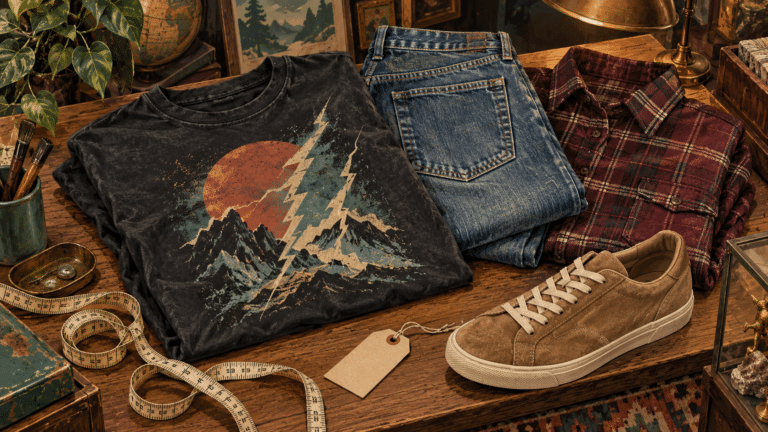
The oversized tee is the cheapest door into the whole look and the deepest category in vintage. Three markers do the dating work:
- Single-stitch hems, which generally point to pre-mid-90s production.
- The blank brands of the day – Screen Stars, Hanes, Fruit of the Loom, Giant – which date a shirt faster than the graphic does.
- A print that has cracked and sunk into the cotton, rather than sitting on top of it.
Our tees and shirts are dated on exactly those markers. If you're buying a graphic tee online and the print is perfectly smooth, assume it's a modern reprint until proven otherwise – the same logic behind our vintage band tee authentication guide.
The finishing pieces
Silhouette gets you 80% there. These close it out:
- Timberland boots – wheat or black, laced loose, worn with the denim breaking over them.
- Bucket hats and caps – including the leather Yankees and the plain wool cap.
- Gold – a chain or two, never a jewellery box.
- Bandanas tied over the head or out of a back pocket.
- A chunky jacket to break the line – puffer, bomber, or a vintage denim or work jacket two sizes up.
The 90s Hip Hop Fashion Brands That Actually Defined the Era
A handful of labels built the visual language of the decade. Very few of them started in a fashion office.
Cross Colours
Carl Jones and T.J. Walker launched Cross Colours in downtown Los Angeles around 1989–1990, with slogans like "Clothing Without Prejudice" and "Educate to Elevate" printed straight onto the clothes. It peaked around 1992–93, when Will Smith, Tupac, TLC and Aaliyah were all photographed in it, and it collapsed mid-decade after retail partner Merry-Go-Round went bankrupt – the story the LA Times documented as the label fell. Nothing else from the era mixed politics and bold colour as directly.
Karl Kani
Brooklyn's Carl Williams started using the name Karl Kani in 1989 and built the label out of street culture rather than design school. He showed at the MAGIC trade show in 1991 as the only Black designer on the floor – a turning point he's talked about in Billboard – and his wide denim and oversized tops ended up on Tupac, Biggie, Nas and Aaliyah. If you only remember one thing: Kani is the reason baggy jeans became the default.
FUBU
In 1992, Daymond John and three friends from Hollis, Queens – Keith Perrin, J. Alexander Martin and Carl Brown – started making hats and screen-printed tees under the name FUBU: "For Us, By Us." John's mother mortgaged the house for $100,000 to fund the first run and the group sold out of street fairs and trade shows before retail ever came calling, as NPR's interview with John recounts. It's the purest example of the era's economy: the clothes were made for the people who wore them, then the mainstream caught up.
Tommy Hilfiger
The tommy hilfiger 90s hip hop fashion crossover is one of the strangest stories of the decade. Grand Puba name-dropped the brand in a 1992 song; Hilfiger responded by sending clothes to artists, including Grand Puba, Raekwon and Snoop Dogg. Snoop wore a Tommy rugby shirt on Saturday Night Live in 1994 and the brand never looked preppy-only again. Aaliyah fronted campaigns and became a company spokesperson in 1997 – the full oral history is in Complex.
Polo Ralph Lauren – and the crews that adopted it
Ralph Lauren never marketed to hip hop, which is exactly why head-to-toe Polo became the ultimate status uniform. The Lo Lifes formed in Brooklyn in 1988 when two Polo-obsessed crews, Ralphie's Kids from Crown Heights and Polo USA from Brownsville, merged – a story the New Yorker told through its photographers. Wu-Tang's Wu-Wear line and Biggie's Coogi sweaters came from the same instinct: wear the logo like armour.
90s Hip Hop Fashion for Women: Aaliyah, TLC and Lil Kim
The 90s hip hop fashion female side of the era gets flattened into "crop top plus baggy jeans." It was wider than that, and the three women below each solved it differently.
Aaliyah: baggy denim, crop top, shades
The 90s hip hop fashion aaliyah formula is the one still being copied most: men's-cut baggy jeans worn low, a small top that stops at the waistband, oversized sunglasses, sneakers or boots. Stylist Derek Lee built the contrast on purpose – hard, boyish denim against something soft and cropped on top. She fronted Tommy Hilfiger campaigns and became the company's spokesperson in 1997, and the looks still hold up frame-for-frame in Vogue's gallery of her 90s outfits.
TLC: oversized tees, overalls, boxer waistbands
The CrazySexyCool era – the album landed in 1994 – gave T-Boz, Left Eye and Chilli the tomboy template the rest of the decade borrowed: oversized tees, baggy pants, boxers deliberately showing above the waistband, and sporty layers in loud colour. Left Eye wore a condom over one lens of her glasses as part of the group's safe-sex messaging, which is the era's brand of provocation in one image. W Magazine's gallery is the place to study the fits.
Lil Kim: fur, logos and no rules
Lil Kim took the other route entirely. Post-Hard Core (1996), her look was floor-length fur, sheer fabric, monogram logos and designer everything – Chanel, Versace, Dior – worn as a flex rather than a costume, including the pink mink at the 1999 Met Gala. You can't shop that literally, and you shouldn't try; what carries over is the principle that a loud logo can be armour. See W Magazine's Lil Kim retrospective.
The rest of the bench
Don't stop at three. Missy Elliott's inflated silhouettes, Da Brat's baggy tomboy uniform, Queen Latifah's head wraps and tailored suiting, Salt-N-Pepa's leather and kente, Foxy Brown's Brooklyn glam and Mary J. Blige's baggy-denim-plus-boots formula are all part of the record.
90s Hip Hop Fashion for Men
The 90s hip hop fashion men actually wore was basically a uniform – learn it and you can build ten outfits from one small closet.
The East Coast uniform: Polo, boots and gold
New York ran on Polo, Timberland boots, Carhartt work jackets, a chain and a cap. The proportions matter more than the brands: the jacket sat oversized, the denim broke over the boots, and the cap sat low. Biggie's Coogi sweaters and Versace frames were the loud end of the same wardrobe.
The West Coast: chambray, bandanas and khaki
LA went lighter and more relaxed – chambray work shirts, khaki, white tees, bandanas, and long, clean denim. Tupac moved between that look and the full Cross Colours and Karl Kani colour-blocking, often in the same era.
The pieces that still work
If you're rebuilding the men's look in 2026, buy in this order:
- One pair of wide, era-correct denim. Everything else hangs off it.
- One oversized single-stitch tee, ideally a graphic.
- A work or varsity layer – Carhartt, a coach jacket, or a heavy hoodie.
- Boots or chunky sneakers. Not both on the same foot, obviously.
- One logo piece, and only one.
The Smithsonian's National Museum of African American History and Culture makes the point that this clothing carried meaning as well as style – it's worth an afternoon on their fashion and hip hop story before you buy anything.
How to Build a 90s Hip Hop Outfit Today
Two formulas, then the rules that stop either from reading as a costume.
Women's 90s hip hop outfit ideas
- The Aaliyah: baggy high-waist denim, cropped tee or bralette, oversized shades, sneakers, small hoop earrings.
- The TLC: oversized graphic tee knotted at the hip, wide carpenter jeans, boxer waistband showing, cap.
- The Lil Kim: slinky top, leather or a faux-fur coat, monogram bag, big jewellery – the most dressed-up end of the spectrum.
- The 96 party fit: vintage denim overalls with one strap down over a white tee, Timberlands, bandana in the pocket.
Men's 90s hip hop outfit ideas
- The everyday: white oversized tee, wide blue denim, wheat boots, chain.
- The Polo fit: baggy Polo-style rugby or hoodie, dark denim, cap, one gold chain.
- The full colour: Cross Colours-style block tee or oversized graphic, dark overalls, sneakers – the loudest version, and the one that needs the cleanest fit underneath.
- The winter version: puffer or work jacket over a hoodie, wide denim, boots.
Rules that keep it from looking like a costume
- One era piece per outfit, maximum two. Six vintage items at once is a theme party.
- Fit the shoulders, not the label. Oversized is about drop, not about wearing a tent.
- Keep the footwear era-correct. Modern chunky runners pull the whole fit into 2026.
- Skip the repro if the original exists. And if you buy the original, know how to date it – our denim and jeans and tees and shirts listings spell out the era details.
- Gold, not glitter. A chain reads 1994. A stack of chains reads TikTok.
Where to Shop Vintage 90s Hip Hop Pieces
A short, honest buying order. Start with our vintage clothing guides if you want the category-by-category detail.
- Vintage denim first. It's the piece with the longest life and the biggest fit risk, so buy it where you can measure it flat.
- Tees and sweatshirts second. Cheapest to learn on, deepest supply. Oversized college crewnecks and band tees do a lot of the heavy lifting for 90s hip hop outfit ideas.
- Outerwear third, because condition matters most here and repairs are expensive.
- Branded era pieces last. A genuine Cross Colours or Karl Kani piece is a nice-to-have, not a foundation – and it's the category where fakes and modern reissues are most common.
- Check the tag, the stitching and the print texture on anything branded before you commit. Ask for close-ups. A seller who won't send them is telling you something.
Outside our own racks, estate sales and church thrift stores in older neighbourhoods still turn up the best stock, and dead-stock lots occasionally surface era-correct pieces with the tags still on.
My Take: Buy the Silhouette, Not the Logo
Most people shopping this era get it backwards. They hunt a logo tee first and try to build around it, then can't work out why the fit looks off. Buy the silhouette first – one pair of properly wide, era-correct denim – and everything else falls in behind it. A used, well-worn tee on great denim beats a dead-stock logo tee on tapered jeans, every single time. And if the "vintage" tee is a smooth modern reprint with a soft, perfectly even print, leave it: you're paying vintage money for 2023 cotton, and it will never fade the way the real thing does.
FAQ: 90s Hip Hop Fashion Questions
Why is 90s hip hop fashion still so popular?
Because the decade's clothes were designed to be worn and copied, not preserved. The silhouettes are forgiving on most bodies, the pieces are easy to find vintage, and the mixing was always democratic – a work jacket and a chain didn't require a stylist. Every few years designers reissue the shapes, which keeps the era in front of a new audience.
What is 90s hip hop fashion female style?
It runs from Aaliyah's baggy denim and crop tops to Lil Kim's fur and logos, with TLC's oversized tomboy look in the middle. The 90s female hip hop fashion shorthand is "big bottoms, small top, big jewellery, shades" – but the era also included Queen Latifah's suiting, Missy Elliott's inflated silhouettes and Da Brat's full baggy uniform. Women's 90s hip hop fashion was never one look.
How do you style 90s hip hop fashion for men without going full costume?
Pick one era anchor – wide denim, a rugby shirt, or boots – and keep the rest of the outfit quiet. Oversized needs drop at the shoulder rather than extra fabric everywhere. Add a cap and one chain, and skip anything that reads as a costume shop prop.
What are the best 90s hip hop outfit ideas for a party?
For women: one strap of a pair of overalls down over a white tee, wide denim, boots, bandana. For men: oversized graphic tee, wide dark denim, wheat boots, chain. Both are cheap to build from vintage, both read instantly in photos, and neither needs a brand name to land.
Which 90s hip hop fashion brands are worth buying today?
Cross Colours (if you can find it in good condition), Karl Kani, FUBU, Tommy Hilfiger, Polo, Wu-Wear and the era's Champion and Carhartt basics. Buy them for the cut and the construction rather than the name – a genuine era piece with a blown-out collar is worth less than a clean unbranded one that fits.
What's the deal with 90s hip hop fashion overalls?
Overalls were the era's most democratic piece: hard-wearing, unisex, and cheap enough that everyone wore them. Style them with one strap down over a tee, in heavy denim rather than thin cotton, and they read more authentically than almost anything else you can buy.
Did Tommy Hilfiger really become a hip hop brand?
Yes, and largely by accident. A Grand Puba lyric in 1992 led to Hilfiger gifting clothes to artists, Snoop Dogg's SNL appearance in 1994 sealed it, and Aaliyah's campaigns and 1997 spokesperson deal made it official. By the late 90s the flag logo sat beside Polo and FUBU in the same wardrobe.
Where does Aaliyah fit into 90s hip hop fashion?
Right at the front. Her baggy denim, cropped tops, sunglasses and Hilfiger campaigns became the template for "street and sweet," and designers have been pulling from her wardrobe ever since. If you want one reference for a first 90s hip hop fit, start with her.
Sources
- FIT Fashion History Timeline – 1990–1999
- NMAAHC (Smithsonian) – Five Things to See in Fashion & Hip Hop
- Los Angeles Times – Cross Colours, 1994 archive feature
- Cross Colours – brand history
- Billboard – Karl Kani, "the godfather of hip-hop style"
- NPR – FUBU and Daymond John
- Wikipedia – FUBU
- Complex – Tommy Hilfiger and hip hop: an oral history
- The New Yorker – the Brooklyn crews who boosted Ralph Lauren
- Vogue – Aaliyah's 90s outfits
- W Magazine – TLC's best 90s fashion
- W Magazine – Lil Kim's best style